
About the Department
- Established: 2010 | Initial Intake: 60 | Current Strength: 167 students (2nd to 4th year)
- VTU Recognized Research Centre: offering Ph.D. programs.
- Faculty Expertise in
- Power Systems
- Power Electronics
- Energy Systems & Management
- Computer Applications in Industrial Drives
- Bio-Medical Signal Processing & Instrumentation
- VLSI Design & Embedded Systems
- Energy Management Systems
- Facilities & Infrastructure
- Laboratories as per VTU norms + upcoming state-of-the-art research labs.
- Spacious infrastructure: 2,025 sq.m with ICT-enabled lecture halls, seminar hall, and modern labs.
- Training & Industry Linkages
- Domain-Specific Training in Industrial Automation and Embedded Systems.
- Active membership in ISTE, IEI, and IAENG.
- Research in Power Systems, Nanomaterials, Bio-Medical Devices, etc.
- Consultancy in transformer design validation, earth pit testing, auxiliary transformer & DG set testing.
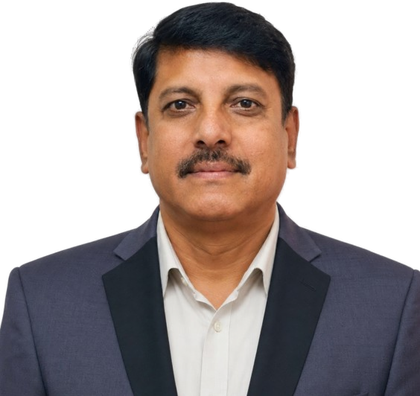
Dr. Parthasarathy L
‘Emitting Elite Energy’
- Educational Approach
- Outcome-Based Education (OBE)
- Experiential Learning for strong theoretical & practical skills.
- Collaboration with reputed training institutes for industry-relevant skills.
- Encouragement for NPTEL/MOOC Certifications for Honors/Minor Degrees.
- Notable Achievements
- Ms. Safeena Shazia (Batch 2011–15) — 8th Rank in VTU.
- AICTE-MODROB funding for Cyber Security in Power Systems.
- Grants from KTECH-NAIN & KSCST for innovative projects.
- Faculty have served as Academic Council Member, BOE Members, Conference Reviewers.
- Student Excellence
- Winners in Technical Project Competitions, Hackathons, and Sports (University, State & District level).
- Active participation in social awareness programs integrated into the curriculum.
- Annual cultural fests themed around impactful societal causes.
We are committed to shaping future-ready engineers through innovation, values, and industry-aligned learning.
Vision
To create Electrical and Electronics Engineers who excel to be technically competent and fulfil the cultural and social aspirations of the society.
Mission
- To provide knowledge to students that builds a strong foundation in the basic principles of electrical engineering, problem solving abilities, analytical skills, soft skills and communication skills for their overall development.
- To offer outcome based technical education.
- To encourage faculty in training & development and to offer consultancy through research & industry interaction.
Programme Educational Objectives (PEOs)
PEO1: To produce competent and ethical Electrical and Electronics Engineers who will exhibit the necessary technical and managerial skills to perform their duties in society.
PEO2: To make graduates continuously acquire and enhance their technical and socio-economic skills.
PEO3: To aspire graduates on R&D activities leading to offering solutions and excel in various career paths.
PEO4: To produce quality engineers who have the capability to work in teams and contribute to real time projects.
Programme Outcomes (POs)
PO1. Engineering Knowledge: Apply fundamental knowledge to solve complex engineering problems.
PO2. Problem Analysis: Identify and formulate complex problems to reach substantiated conclusions.
PO3. Design/Development of Solutions: Create solutions that meet specific needs, considering health, safety, and environmental factors.
PO4. Conduct Investigations of Complex Problems: Use research-based methods to design experiments, analyze, and interpret data.
PO5. Engineering Tool Usage: Select and apply modern techniques and IT tools to engineering activities.
PO6. The Engineer and the World: Understand the impact of professional engineering solutions on society and the environment.
PO7. Ethics: Commit to professional ethics and responsibilities.
PO8. Individual and Collaborative Team Work: Function effectively as an individual or team member in multidisciplinary settings.
PO9. Communication: Communicate effectively regarding complex engineering activities with the engineering community and society.
PO10. Project Management and Finance: Apply management and financial principles to project work.
PO11. Life-Long Learning: Engage in independent and life-long learning in the context of technological change.
Programme Specific Outcomes (PSOs)
PSO1: Apply the concepts of Electrical & Electronics Engineering to evaluate the performance of power systems and also to control industrial drives using power electronics.
PSO2: Demonstrate the concepts of process control for Industrial Automation, design models for environmental and social concerns and also exhibit continuous self-learning.
Course
| Programme | Leading to… | Duration | Intake |
|---|---|---|---|
| Electrical & Electronics Engineering | B.E (EEE) | 4 Years | 60 |
Short Term Goals
- Leveraging technology for Teaching & Learning Process: Video based Learning, NPTEL & MOOCS.
- Professional Body Activities — ISTE, IEI, IEEE.
- Endeavour to obtain sponsors for Workshops and FDPs.
- Encourage the Faculty members to publish papers in reputed International Journals and Conferences.
Long Term Goals
- To achieve recognition of excellence in undergraduate education in the fields of Electrical & Electronics Engineering.
- To achieve distinguished academic results.
- To participate in the project sponsored by NGO's, State & Central government bodies.
- Work in close cooperation with industry and professional bodies.
Class Incharge — EEE (Academic Year 2026–27)
| Sl. No. | Year | Section | Class Incharge | Mail ID | Phone |
|---|---|---|---|---|---|
| 1 | II | A | Prof. Geetha M A | geethama.ee@atme.edu.in | 9482661338 |
| 2 | III | A | Dr. Sathish K R | dr.sathishkr_ee@atme.edu.in | 9611982696 |
| 3 | IV | A | Prof. Shreeshayana R | shreeshayanar_ee@atme.edu.in | 9739002631 |