

Infrastructure
Infrastructure/Facilities
Department of computer science and engineering has seven state of art laboratories. All labs are highly equipped with sufficient systems with all the necessary software and hardware tools required for conducting the experiments. Department of Computer Science and Engineering has qualified and experienced staff members to provide high quality education and attention to individual student is given.
Department Library
The library of CSE department is having 1110 books and information resources. The department is catering to aspirants quench for knowledge by adding good number of books to its department Library racks
The library serves as a central organ of academic activity in the Department. The Department has a rich & vast collection of more than 661 books, periodicals and reports. It also has one copy each of all B.E. projects reports carried out in the department in recent years. All these cater to the needs of students and faculty. Most of the books are of recent edition with the facility of issuing these for a specified time period. Department library also provide the services of librarians who are experts at finding and organizing information and at interpreting information needs.
Laboratory Details
Lab Name – ADE/MP Lab
Microcontrollers Laboratory
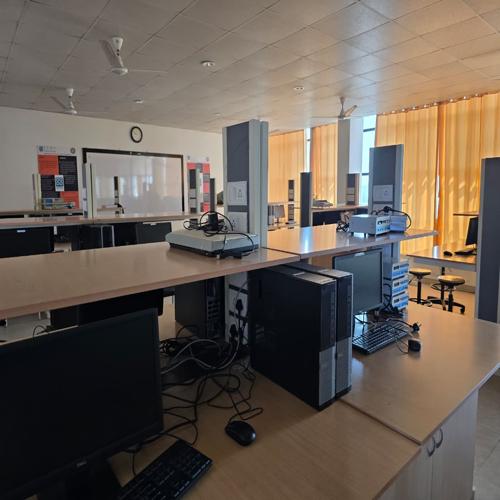
The Microcontrollers Laboratory provides hands-on experience with the architecture, programming, and interfacing of microcontrollers, which are the core components of modern embedded systems. A microcontroller is an integrated chip that contains a processor, memory, and input/output peripherals, enabling it to perform dedicated control functions in real-time applications.
This laboratory focuses on understanding the internal structure of microcontrollers, instruction sets, and programming techniques using both assembly language and high-level languages. Students learn to interface microcontrollers with external devices such as LEDs, switches, sensors, displays, motors, and communication modules.
Through systematic experiments, the laboratory emphasizes practical skills including program development, debugging, hardware interfacing, and system testing. The knowledge gained in this lab is essential for designing and developing embedded systems used in applications such as industrial automation, consumer electronics, automotive systems, medical devices, and IoT applications.
Overall, the Microcontrollers Laboratory bridges the gap between theoretical concepts and real-world embedded system design, preparing students for advanced study and industry-oriented applications.
Analog and Digital Electronics Laboratory
The Analog and Digital Electronics Laboratory plays a vital role in engineering education by providing practical exposure to the fundamental concepts of electronics. This lab enables students to understand, analyze, and implement electronic circuits that form the backbone of modern electronic systems.
In the analog electronics section, students study devices such as diodes, bipolar junction transistors (BJTs), field-effect transistors (FETs), and operational amplifiers. Experiments focus on characteristics, biasing techniques, amplifiers, oscillators, and signal processing circuits, helping students understand continuous-time and continuous-amplitude signals.
The digital electronics section introduces students to digital logic concepts using logic gates, combinational and sequential circuits, flip-flops, counters, registers, and basic digital ICs. Students learn how binary information is processed and how digital systems are designed and tested.
This laboratory emphasizes hands-on learning, circuit simulation, troubleshooting, and measurement using instruments such as CROs, function generators, power supplies, and multimeters. The knowledge gained from this lab bridges the gap between theory and real-world applications, preparing students for advanced studies and careers in electronics, communication, embedded systems, and related fields.
Lab Name – Project/Web Lab
Web Technology Lab
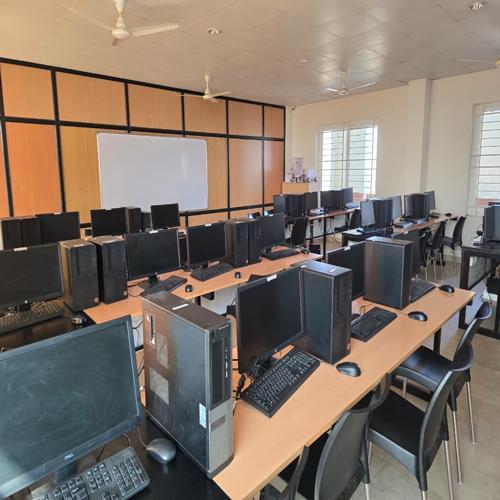
The Web Technology Lab provides practical exposure to the fundamental and advanced concepts of web development. This lab focuses on designing, developing, and deploying dynamic and interactive web applications using modern web technologies.
Through hands-on experiments, students learn how to create well-structured web pages using HTML, apply styling and layouts using CSS, and implement client-side interactivity using JavaScript. The lab also introduces server-side technologies, databases, and frameworks that enable the development of full-stack web applications.
The Web Technology Lab helps students understand the complete web development lifecycle, including requirement analysis, design, implementation, testing, and deployment. It enhances problem-solving skills, creativity, and technical proficiency required for building scalable and user-friendly web applications.
By the end of this lab, students gain practical knowledge of web standards, responsive design principles, and real-world application development, preparing them for careers in software development, web engineering, and related fields.
Project Lab
The Final Year Project Laboratory is an integral part of the engineering curriculum, designed to provide students with practical exposure to real-world problem solving. This laboratory enables students to apply the theoretical knowledge gained during their course of study to design, develop, and implement an innovative engineering solution.
The primary objective of the Project Lab is to enhance students’ technical competence, analytical thinking, and research skills. Through this project, students work on identifying a problem, reviewing existing literature, selecting appropriate methodologies, and implementing effective solutions using modern tools and technologies. The project work also encourages teamwork, project planning, documentation, and presentation skills, which are essential for professional engineering practice.
By completing the Final Year Project Laboratory, students gain hands-on experience in system design, development, testing, and evaluation. This practical exposure prepares students to meet industry requirements, pursue higher studies, and engage in research and development activities. Overall, the Project Lab serves as a bridge between academic learning and real-time engineering applications.
Lab Name – DAA/Data structure lab
The Data Structures Laboratory
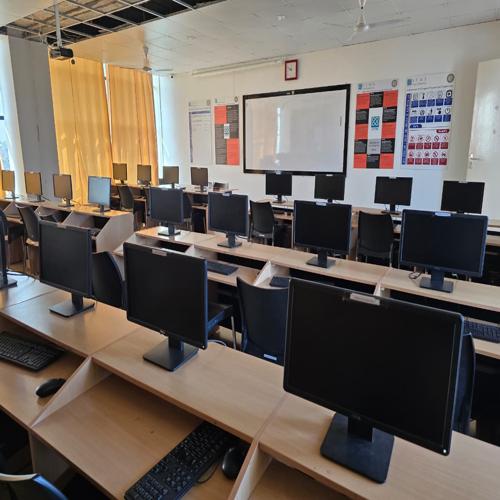
The Data Structures Laboratory is designed to provide practical exposure to the fundamental concepts of data structures and their applications in problem solving. Data structures are systematic ways of organizing, storing, and managing data so that it can be accessed and modified efficiently.
In this laboratory, students implement various data structures using programming languages such as C / C++ / Java / Python and analyze their performance. The experiments help in understanding how different data structures work internally and how they can be applied to real-world computational problems.
The lab focuses on both linear and non-linear data structures, including arrays, stacks, queues, linked lists, trees, graphs, and hashing techniques. Emphasis is given to algorithm design, time and space complexity analysis, and selection of appropriate data structures for efficient solutions.
By performing these experiments, students develop strong programming skills, logical thinking, and the ability to design optimized algorithms, which are essential for software development and advanced engineering applications.
Design and Analysis of Algorithms (DAA) Lab
The Design and Analysis of Algorithms (DAA) Lab is an integral part of the Computer Science and Engineering curriculum. This laboratory aims to provide hands-on experience in designing, implementing, and analyzing algorithms to solve computational problems efficiently.
In this lab, students learn to apply various algorithmic techniques such as divide and conquer, greedy methods, dynamic programming, backtracking, and branch and bound.
The lab enhances programming skills by implementing algorithms using suitable programming languages and analyzing their performance for different input sizes. Through systematic experimentation and analysis, students gain insights into algorithm efficiency, correctness, and scalability.
Overall, the DAA Lab helps students develop strong problem-solving abilities and prepares them for advanced studies, competitive programming, and real-world software development where algorithmic efficiency is critical.
Lab Name – Machine Learning lab
Machine Learning Laboratory
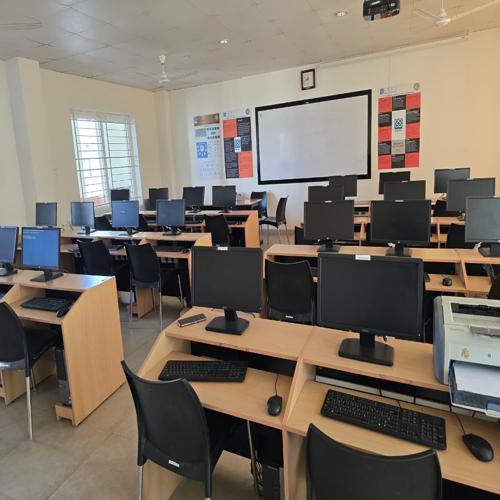
Machine Learning (ML) is a subfield of Artificial Intelligence that focuses on developing algorithms and statistical models which enable computer systems to learn patterns from data and make predictions or decisions without being explicitly programmed. With the rapid growth of data and computational power, machine learning has become a core technology in modern engineering applications.
The Machine Learning Laboratory aims to provide practical exposure to fundamental and advanced machine learning techniques. In this lab, students gain hands-on experience in data preprocessing, feature extraction, model building, training, testing, and performance evaluation using real-world datasets. The laboratory experiments cover major learning paradigms such as supervised learning, unsupervised learning, and reinforcement learning.
Through this laboratory, students will implement various algorithms including linear regression, logistic regression, decision trees, k-nearest neighbors, support vector machines, clustering techniques, and neural networks using programming tools such as Python and popular machine learning libraries. The lab bridges the gap between theoretical concepts and real-time applications, enhancing problem-solving skills and analytical thinking.
Overall, the Machine Learning Laboratory equips engineering students with essential skills required to design intelligent systems for applications in areas such as data analytics, computer vision, natural language processing, healthcare, finance, and automation.
Lab Name – CN/CG Lab
Computer Networks Laboratory
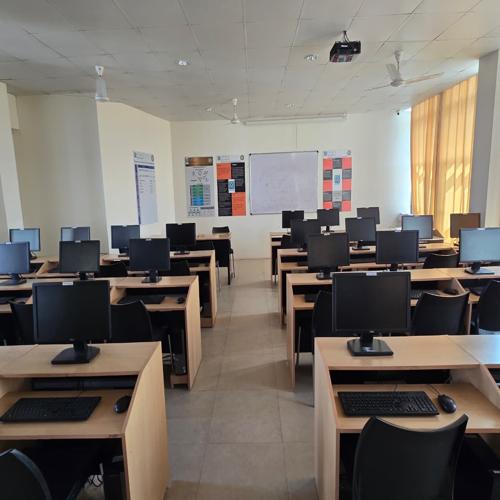
The Computer Networks Laboratory is designed to provide practical exposure to the fundamental concepts of data communication and computer networking. This laboratory enables students to understand how computers and network devices are interconnected to share data and resources efficiently.
Through hands-on experiments, students gain experience with network topologies, protocols, IP addressing, routing, switching, and network configuration. The lab bridges the gap between theoretical concepts and real-world networking applications by allowing students to configure, analyze, and troubleshoot network systems.
The laboratory is equipped with modern computers, networking devices, and software tools that support experiments related to LAN, WAN, OSI and TCP/IP models, socket programming, network simulation, and performance analysis. By working in this lab, students develop practical skills essential for careers in networking, cybersecurity, cloud computing, and system administration.
Overall, the Computer Networks Laboratory plays a vital role in enhancing students’ technical competence, problem-solving ability, and readiness for industry-level networking challenges.
Cloud Technology Lab
The Cloud Technology Lab is designed to provide engineering students with practical exposure to modern cloud computing platforms, services, and architectures. Cloud computing has become a cornerstone of today’s IT infrastructure, enabling scalable, flexible, and cost-effective solutions for computing, storage, and networking.
Objectives of the Lab:
- To understand the fundamentals of cloud computing, including IaaS (Infrastructure as a Service), PaaS (Platform as a Service), and SaaS (Software as a Service).
- To gain hands-on experience with leading cloud platforms such as AWS (Amazon Web Services), Microsoft Azure, Google Cloud Platform (GCP), and OpenStack.
- To learn deployment, management, and scaling of applications in a cloud environment.
- To explore virtualization, containerization (Docker, Kubernetes), and cloud security principles.
- To develop skills in building cloud-based solutions for real-world engineering problems.
Lab Activities:
- Setting up virtual machines and storage in the cloud.
- Configuring and deploying web applications using cloud services.
- Implementing serverless computing and microservices.
- Practicing cloud networking and load balancing.
- Monitoring and managing cloud resources efficiently.
Learning Outcomes:
- Design and deploy cloud-based applications.
- Utilize cloud infrastructure for scalable and resilient systems.
- Apply security measures and best practices in cloud environments.
- Analyze performance metrics and optimize cloud resource usage.
Importance in Engineering:
Cloud computing has transformed software development, data management, and enterprise solutions. By mastering cloud technologies, engineering students can innovate, optimize, and implement modern solutions in fields like IoT, AI/ML, big data analytics, and web services.
DBMS Lab
A Database Management System (DBMS) is software that enables the creation, management, and manipulation of databases. It provides an interface between users and databases to efficiently store, retrieve, and manage data. DBMS plays a vital role in modern engineering applications where data handling, processing, and analysis are crucial.
Objectives of DBMS Lab
- To understand the fundamental concepts of database systems.
- To learn how to design and implement databases using relational models.
- To develop skills in writing SQL queries for data manipulation and retrieval.
- To gain hands-on experience in database management tools like MySQL, Oracle, or PostgreSQL.
- To understand transaction management, data integrity, and security concepts in databases.
Key Topics Covered
- Database Design: Entity-Relationship (ER) modeling, schema design, normalization.
- DDL (Data Definition Language) – CREATE, ALTER, DROP
- DML (Data Manipulation Language) – INSERT, UPDATE, DELETE, SELECT
- DCL (Data Control Language) – GRANT, REVOKE
- TCL (Transaction Control Language) – COMMIT, ROLLBACK
- Joins and Views: Inner join, outer join, self join, views, and indexes.
- Stored Procedures & Functions: Writing and executing stored procedures for efficient database operations.
- Triggers and Constraints: Ensuring data integrity and automating tasks.
- Transaction Management: Concurrency, commit, rollback, and ACID properties.
Learning Outcomes
- Design relational databases for real-world applications.
- Write efficient SQL queries to retrieve and manipulate data.
- Implement database constraints, triggers, and stored procedures.
- Understand and apply transaction management for consistent and reliable data handling.
- Gain practical experience with DBMS tools and software widely used in engineering and industry.
DevOps Lab
DevOps is a combination of Development (Dev) and Operations (Ops) practices aimed at automating and integrating the processes between software development and IT operations.
Objectives of a DevOps Lab
- Provide hands-on experience with DevOps tools and practices.
- Enable students to set up CI/CD pipelines.
- Teach containerization and orchestration using Docker and Kubernetes.
- Demonstrate infrastructure as code (IaC) using tools like Ansible, Terraform, or Puppet.
- Implement monitoring and logging for real-time applications.
- Encourage collaboration and agile workflows among teams.
Typical Lab Setup
Hardware Requirements:
- Computers/servers with internet access, virtualization support, enough RAM (16 GB recommended) for containers/VMs.
Software Requirements:
- OS: Linux (Ubuntu, CentOS) or Windows Subsystem for Linux (WSL)
- Docker and Kubernetes installed
- Jenkins or any CI/CD server
- Version control system (Git)
Lab Activities
- Installing and configuring Git and GitHub repositories.
- Building a CI/CD pipeline using Jenkins for automated builds and deployments.
- Creating and managing Docker containers and Kubernetes pods.
- Writing Ansible playbooks for automated server configuration.
- Setting up monitoring dashboards using Grafana and Prometheus.
- Deploying applications on cloud platforms (AWS EC2, Azure VMs).