
Infrastructure & Facilities
The Master of Computer Applications (MCA) programme is supported by a robust infrastructure that facilitates effective teaching, practical learning, and skill development. The department provides spacious ICT-enabled classrooms equipped with LCD projectors, smart boards, audio-visual systems, and internet connectivity to enhance the teaching-learning process.
Dedicated computer laboratories with modern computing systems, licensed software, and high-speed internet access enable students to gain hands-on experience in programming, database management systems, web technologies, mobile application development, and emerging areas such as Artificial Intelligence and Cybersecurity.
Students have access to a well-stocked library with textbooks, reference books, journals, e-resources, and online learning platforms to support academic excellence. Seminar halls equipped with multimedia facilities are utilised for technical talks, workshops, guest lectures, project presentations, and skill enhancement programmes.
Campus-wide Wi-Fi, uninterrupted power supply through UPS and generators, project development facilities, and career guidance support further contribute to creating a conducive environment for academic growth and industry readiness.
The department has adequate classrooms and laboratories to support academic activities. Each classroom is equipped with a projector to facilitate effective teaching and learning. All laboratories are well equipped as per VTU norms.
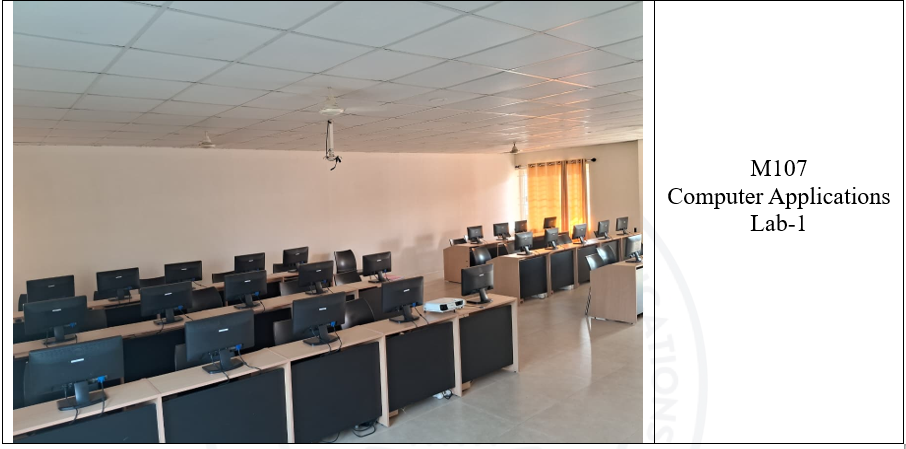
Laboratories & Seminar Hall
Major equipment and software tools available in the various MCA laboratories:
- ▸Dell Desktops, i3 Processors, 4 GB RAM, 500 GB Hard Disk
- ▸HP Desktops, i5 Processors, 4 GB RAM, 1 TB Hard Disk
- ▸System Software: OS — Windows 10 & Linux
- ▸Application Software: XAMPP, JDK & JRE (Version 8), Turbo C, Microsoft Office (Edition 16), Anaconda, Code::Blocks, MySQL
Computer Programming Laboratory
Objectives: To develop problem-solving and logical thinking skills through structured and object-oriented programming; to provide hands-on experience in programming using C and Java for developing software applications; to enable students to design, implement, test, and debug programs using modern programming techniques.
Lab Activities: Writing and executing programs using C programming concepts such as control structures, functions, arrays, pointers, structures, and file handling; developing Java programs using classes, objects, inheritance, polymorphism, exception handling, and collections; implementing algorithms for searching, sorting, and data processing; developing mini-projects and application-based programming assignments; debugging, testing, and optimising programs for improved performance.
Learning Outcomes: Apply structured programming concepts using C to solve computational problems; develop object-oriented applications using Java programming principles; analyse, design, and implement efficient software solutions; demonstrate programming, debugging, and software development skills required for industry and higher studies.
Importance: The Computer Programming Laboratory serves as the foundation for software development by equipping students with essential programming skills in both C and Java. It enhances logical reasoning, algorithmic thinking, and problem-solving abilities while providing practical exposure to structured and object-oriented programming paradigms. The laboratory prepares students for advanced computing courses, software development projects, competitive programming, and careers in the IT industry.
Python and UNIX Programming Laboratory
Objectives: To provide hands-on experience in Python programming and UNIX/Linux operating system environments; to develop problem-solving, scripting, and automation skills using Python and Shell Programming; to enable students to design and implement software solutions and system administration tasks efficiently.
Lab Activities: Developing Python programs using control structures, functions, modules, file handling, and object-oriented programming concepts; implementing applications using Python libraries and frameworks; performing file, directory, user, and process management tasks in UNIX/Linux; writing and executing Shell Scripts using loops, conditional statements, and functions; automating routine system tasks and solving real-world computing problems; developing mini-projects integrating Python programming and UNIX/Linux tools.
Learning Outcomes: Apply Python programming concepts to develop efficient software applications; utilise UNIX/Linux commands and utilities for system operations and administration; design and implement shell scripts for task automation and process management; demonstrate proficiency in programming, debugging, and problem-solving in diverse computing environments.
Importance: The Python and UNIX Programming Laboratory provides students with a strong foundation in both application development and system-level computing. By combining Python programming with UNIX/Linux administration and shell scripting, the laboratory enhances analytical thinking, automation skills, and practical computing expertise. The knowledge gained through this laboratory is highly relevant to careers in software development, cloud computing, DevOps, cybersecurity, data analytics, and system administration.